ADA Door Hardware Compliance for Huntington Beach Businesses
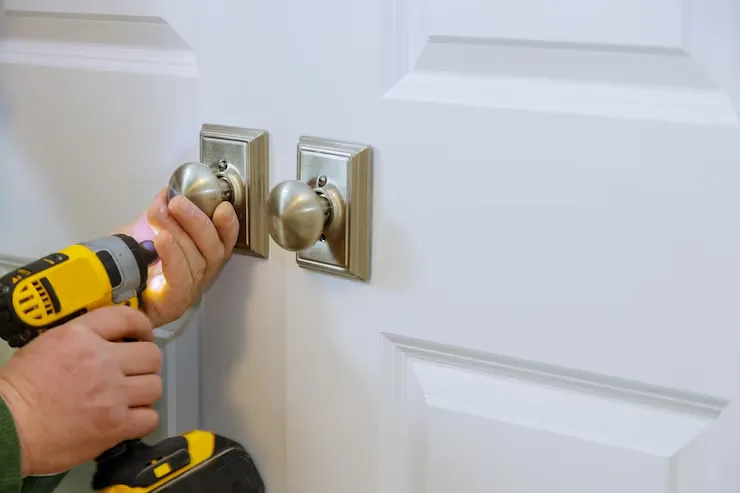
A round doorknob on an accessible route is a code violation. So is a lever handle mounted at 52 inches. So is a door closer cranked so tight that a person using a wheelchair cannot push it open without exceeding 5 pounds of force.
None of these are obvious. All of them are common in Huntington Beach commercial buildings — in retail storefronts along Beach Blvd, in office suites in the Gothard Industrial Corridor, in restaurants near the Pier, and in medical offices throughout Orange County. The ADA door hardware requirements for commercial buildings cover seven distinct categories, and California adds its own rules on top. A single non-compliant element can expose a business owner to a minimum $4,000 fine per violation under the Unruh Civil Rights Act, without the plaintiff needing to prove actual damages.
Golden Locks, Inc. holds CA Contractor License #988707 and CA Locksmith License #LCO4446. We have installed and audited commercial door hardware for Huntington Beach businesses since 2008. This guide covers exactly what the law requires, where California’s rules are stricter than the federal ADA, and what non-compliant hardware looks like in the field.
What Laws Apply to Commercial Door Hardware in California?
Huntington Beach business owners face two separate but overlapping compliance frameworks.
The first is the federal Americans with Disabilities Act (ADA), codified in the 2010 ADA Standards for Accessible Design, Section 404. This is a civil rights law enforced by the U.S. Department of Justice and through private litigation.
The second is the California Building Code (CBC), Title 24, Part 2, Chapter 11B. This is a state building code enforced by local jurisdictions during plan check and permit issuance. Chapter 11B applies to public accommodations and commercial facilities — which includes virtually every business open to the public in HB.
The critical rule: when the two standards differ, the more restrictive one governs. California’s CBC Chapter 11B is stricter than the federal ADA in multiple door hardware categories. Meeting the ADA minimum does not mean you are compliant in California. Both must be satisfied simultaneously. Golden Locks, Inc. checks both frameworks on every commercial hardware job in Huntington Beach, since passing one and missing the other still leaves a business exposed.
The 7 ADA Door Hardware Requirements for Commercial Buildings
1. Hardware Type — No Round Knobs on Accessible Routes
The ADA prohibits any door hardware on an accessible route that requires tight grasping, pinching, or twisting of the wrist to operate. This language from Section 404.2.7 effectively bans round doorknobs on any commercial door along an accessible path.
Compliant hardware types include lever handles, push-pull bars, U-shaped pulls, and panic bars. The hardware must be operable with one hand using a loose grip or closed fist.
In practice, this means every public-facing door in a Huntington Beach business — entrance doors, restroom doors, conference room doors, break room doors — must have lever handles or equivalent accessible hardware if located on an accessible route. Round knob hardware on restroom doors is one of the most common violations Golden Locks, Inc. finds during commercial hardware audits across Orange County.
2. Hardware Mounting Height — 34 to 48 Inches
All operable hardware on accessible doors must be mounted between 34 inches and 48 inches above the finished floor. The standard commercial installation height for lever hardware is 38 to 42 inches, which sits within this range.
The violation typically occurs on secondary or utility doors where contractors install hardware at standard residential height (typically 36 inches to centerline of knob) without checking the operable-parts range — or when doors are modified after installation and hardware is relocated without re-measuring.
3. Door Opening Force — 5 Pounds for Interior Doors, Higher for Exterior
This is the requirement most often missed — and in California, it is strictly enforced.
Interior hinged doors on accessible routes must require no more than 5 pounds-force (lbf) to open. This limit applies to the continuous force needed to swing the door from a closed position, measured separately from the force to operate the latch hardware.
Exterior hinged doors are not held to the 5 lbf interior standard, since the federal ADA Standards do not set a specific number for them. In practice, exterior doors are commonly built and inspected to a range of roughly 8.5 to 10 lbf, accounting for weatherstripping, wind load, and the heavier closers needed outdoors. Fire doors are a separate case entirely and may require the minimum closing force permitted under the applicable fire code, which is typically higher than 5 lbf.
The 5 lbf limit affects door closer selection and adjustment on interior doors. Most commercial door closers have separate valves for main-sweep speed (90 degrees to 12 degrees), latching speed (the final pull to closed), and backcheck pressure. A closer set too tight for the door’s weight will exceed 5 lbf and fail an accessibility inspection. Golden Locks, Inc. adjusts and calibrates door closers to the correct sweep force on every commercial installation across Huntington Beach and Orange County.
4. Clear Opening Width — 32 Inches Minimum, 36 Inches Recommended
ADA Section 404.2.3 requires a minimum clear opening of 32 inches, measured from the face of the door to the opposite stop when the door is open 90 degrees. This is the minimum — the standard recommended practice and the width specified in most accessibility upgrades is 36 inches, which accommodates a broader range of wheelchairs and mobility devices without the user angling through the opening.
The most common width violation in older HB commercial properties is a 30-inch door that was standard in pre-1992 construction. Even if the door itself is 32 inches nominal, the clear opening shrinks once the door thickness and any protruding hardware is subtracted from the measurement.
5. Threshold Height — ½ Inch Maximum
Thresholds at accessible doorways must not exceed ½ inch in height. Thresholds between ¼ inch and ½ inch must be beveled with a slope no steeper than 1:2. This rule prevents tripping hazards and ensures smooth passage for wheelchairs, walkers, and other mobility devices.
Saddle thresholds — common in older commercial storefronts along Beach Blvd and Pacific Coast Highway — frequently exceed this limit and are one of the most straightforward correctable violations Golden Locks, Inc. finds during an ADA compliance audit.
6. Maneuvering Clearance — Approach Space Around the Door
Adequate floor space around the door on both sides must allow a wheelchair user to approach, operate the hardware, and pass through without repositioning. The required clearance dimensions vary by approach direction and whether the door swings toward or away from the user:
- Front approach, push side: 48 inches perpendicular to the door
- Front approach, pull side: 60 inches perpendicular, plus 18 inches beyond the latch side
- Latch-side approach, pull side: 60 inches parallel, 24 inches perpendicular
The latch-side clearance is where most Huntington Beach businesses fail. A door positioned in a corner or against a wall without 18 inches of latch-side clearance on the pull approach is non-compliant, even if the door width and hardware are correct. This is a fixed constraint that often requires door relocation or reversal of swing direction to correct.
7. Closing Speed — Door Closer Timing
If a door has an automatic closer, ADA Section 404.2.8 requires that from an open position of 90 degrees, the door takes at least 5 seconds to move to a position of 12 degrees. A closer adjusted for a fast sweep — common in high-traffic commercial entries where a fast close is preferred — may not provide enough time for a person using a mobility device to clear the doorway.
Door closer timing is adjusted separately from sweep force, and both must be set to comply simultaneously. A slow sweep that still requires excessive force to open is non-compliant. A correctly timed closer that is too heavy to push open is non-compliant. Both variables must be dialed in together.
California Title 24 vs. Federal ADA: Where California Is Stricter
California’s CBC Chapter 11B goes beyond the federal ADA in several door hardware categories. These differences are where Huntington Beach businesses most often find themselves non-compliant with California law even after passing a basic ADA review:
Panic bar operating force: The federal IBC allows up to 15 lbf to activate a panic bar. California’s adoption of the 2010 ADA Standards made the 5 lbf maximum applicable to panic hardware on accessible routes — a significantly more stringent requirement. Standard commercial panic hardware often operates at 8 to 12 lbf. In California, compliant units must be certified to CBC Section 11B-309.4, such as the Von Duprin AX series rated for 5 lbf activation. Golden Locks, Inc. verifies this certification before installing any panic hardware on a Huntington Beach commercial property.
Minor alterations trigger full compliance: Under Title 24, even a minor alteration to a commercial space can trigger accessibility upgrade requirements on the path of travel to the altered area. Replacing flooring, updating a restroom fixture, or repainting can trigger a door hardware compliance review under the CBC — even if no door-related work was planned.
The Unruh Civil Rights Act: California’s state civil rights law makes any ADA violation automatically a violation of state law, with a minimum statutory damage of $4,000 per incident. Unlike federal ADA enforcement, plaintiffs do not need to prove they personally experienced difficulty — the violation itself is sufficient. Orange County has an active litigation environment around accessibility, and commercial properties on accessible public routes are commonly targeted.
Panic Bars: When Are They Required, and What Must They Meet?
A panic bar — also called an exit device or crash bar — is horizontal hardware mounted on the interior side of an egress door that releases the latch when pressure is applied in the direction of exit travel.
When panic bars are required: Under California Building Code and IBC Section 1010.1.9, panic hardware is required on egress doors serving an occupant load of 50 or more in assembly, educational, and high-hazard occupancies. Requirements can apply at lower occupant loads for some occupancy types, so a Huntington Beach business should confirm its specific occupancy classification rather than relying on the 50-person threshold alone. Many HB business owners also install panic bars voluntarily on rear exit and loading dock doors for ADA compliance, security, and fire code purposes.
Hardware grade: All commercial panic hardware must meet ANSI A156.3 Grade 1, rated to a minimum of 1,000,000 operating cycles. Grade 2 panic hardware has no legitimate application on any commercial egress door subject to AHJ inspection in California.
Fire door requirement: When a panic bar is installed on a fire-rated door assembly, it must be fire exit hardware — listed under both UL 305 (panic) and UL 10C (positive pressure fire testing). Fire exit hardware cannot use mechanical dogging (holding the latch retracted during business hours), because fire-rated doors must positively latch when closed under NFPA 80. If push-pull operation during business hours is needed on a fire-rated door, the correct solution is electric dogging tied to the fire alarm panel, which releases automatically on alarm activation to restore positive latching.
Golden Locks, Inc. installs ANSI Grade 1 panic hardware, fire exit devices, and electric dogging systems for commercial properties across Huntington Beach and Orange County. See our commercial locksmith service page for a full list of door hardware we supply and install.
Common Non-Compliant Door Hardware Situations in HB Commercial Buildings
In 16 years of commercial locksmith work across Huntington Beach, these are the hardware violations Golden Locks, Inc. finds most often:
Round knobs on restroom doors. Ubiquitous in pre-2000 construction. A direct ADA Section 404.2.7 violation on any accessible route.
Door closers set for fast-sweep speed. Common in high-traffic retail entries. Almost always exceeds the 5-second timing requirement and often exceeds the 5 lbf force limit simultaneously.
Panic bars exceeding 5 lbf in California. Standard commercial panic devices from major manufacturers often operate at 8 to 12 lbf. California requires 5 lbf maximum on accessible routes, regardless of federal IBC allowance.
Hardware mounted above 48 inches. Found frequently on exterior doors in older construction where lever handles were added after the fact, installed at a height that felt natural to the installer rather than measured against the ADA range.
Thresholds above ½ inch. Common in storefronts along Beach Blvd and in restaurant entries with tile transitions. Often under ½ inch total height but not beveled correctly.
Interior door guards and door stops blocking maneuvering clearance. A door guard or barricade device installed incorrectly can reduce the effective clear width below 32 inches or obstruct the approach clearance on the pull side.
If your Huntington Beach business has never had a commercial door hardware audit, the issues above are where to start. Our commercial door repair and hardware service covers hardware replacement, closer adjustment, threshold correction, and full ADA compliance upgrades across Orange County.
Access Control and ADA: How They Work Together
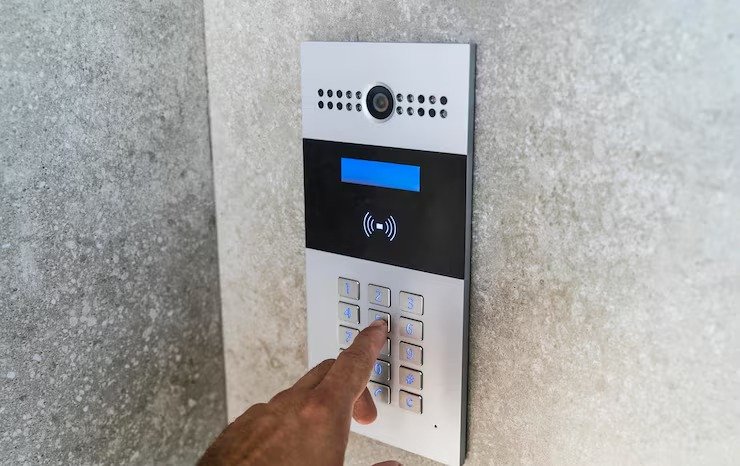
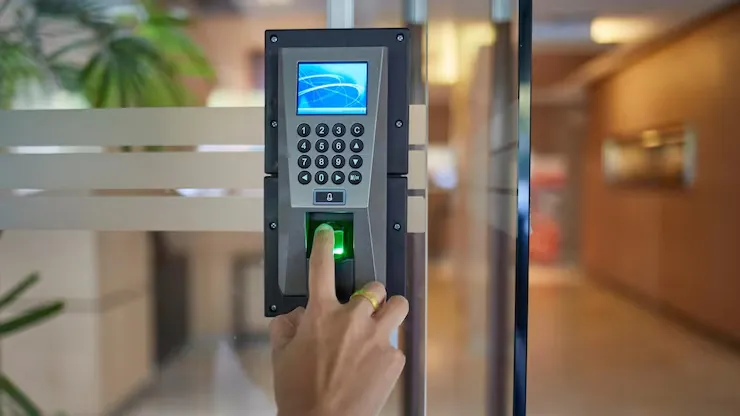
Access control systems — keypads, card readers, biometric scanners — introduce new compliance variables that standard door hardware audits don’t always address.
Any access control hardware installed on an accessible route must be mounted between 15 inches and 48 inches above the floor for a forward approach, or between 9 inches and 54 inches for a side approach, under ADA Section 308. A keypad mounted at 58 inches is non-compliant, regardless of the lock mechanism behind it.
Doors on accessible routes equipped with access control must also allow egress without special knowledge or tools. A maglock on an exterior door must fail-safe (release on power failure) and must have an accessible interior release that operates within the 5 lbf limit. An electric strike on an accessible entry must not add to the opening force beyond the 5 lbf ceiling.
Golden Locks, Inc. designs and installs access control systems that satisfy both ADA compliance and California code requirements. Our access control installation service covers keycard, keypad, and biometric systems for single and multi-door commercial deployments across HB and surrounding Orange County cities.
What Triggers a Full ADA Door Hardware Upgrade?
Three situations require a Huntington Beach business to bring door hardware into full compliance:
New construction — any commercial building permitted after January 26, 1992 must be fully accessible in all public-facing areas from opening day.
Alteration or tenant improvement — any renovation to a commercial space triggers accessibility compliance for the area of new work and the path of travel to it, including doors. This is where most Orange County businesses are caught off guard. Repainting a restroom, changing flooring, or adding a counter can trigger a door hardware upgrade requirement on every door in the path of travel to that space.
Readily achievable barrier removal — for existing facilities built before 1992 that have not been altered, the ADA requires ongoing removal of accessibility barriers where it is readily achievable (does not require significant difficulty or expense). Hardware replacement generally qualifies as readily achievable and is therefore not exempt.
Frequently Asked Questions
What ADA requirements apply to door hardware in commercial buildings?
ADA Section 404.2.7 requires all door hardware on accessible routes to be operable with one hand, without tight grasping, pinching, or twisting. Hardware must be mounted between 34 and 48 inches above the finished floor. Opening force for interior doors must not exceed 5 pounds. Round doorknobs are prohibited. In California, these requirements are enforced through CBC Chapter 11B, which applies the same 5-pound force limit to panic hardware — stricter than the federal IBC standard of 15 pounds.
Do all commercial doors in Huntington Beach need to meet ADA standards?
Every door on an accessible route in a public-facing commercial building must meet ADA and California CBC Chapter 11B requirements. This includes entrance doors, restroom doors, interior corridor doors, and any door a customer or employee with a disability would use to access the business or its services. Doors that are exclusively service or maintenance access, with no public or employee traffic, may be exempt, but this determination should be made by a licensed professional or CASp inspector.
What is the difference between ADA and California Title 24 for door hardware?
California’s Title 24, specifically CBC Chapter 11B, exceeds the federal ADA in several door hardware categories, and the stricter standard governs whenever the two conflict. The most significant difference for commercial properties in Huntington Beach is the 5-pound operating force limit for panic hardware — the federal IBC allows up to 15 pounds. The federal ADA sets the nationwide floor; California requires both standards to be met at once.
Are panic bars ADA compliant in California?
Standard commercial panic bars are not automatically ADA compliant in California. The CBC Chapter 11B requires panic hardware on accessible routes to operate with no more than 5 pounds of force — significantly stricter than the 15-pound limit in the federal IBC. Compliant units must be specifically certified to California’s 5-pound standard, such as the Von Duprin AX series. Golden Locks, Inc. installs CBC-compliant panic hardware for Huntington Beach commercial properties and verifies force calibration on every installation.
How much does ADA door hardware installation cost for a commercial building in Huntington Beach?
ADA hardware upgrades range from minimal (lever handle replacement on a single interior door) to comprehensive (full hardware replacement, closer adjustment, threshold correction, and maneuvering clearance modifications across multiple doors). Golden Locks, Inc. provides written quotes before any work begins. Call (714) 841-0141 or visit our showroom at 16371 Gothard St, Suite G in Huntington Beach for a commercial hardware assessment.
What happens if a Huntington Beach business has non-compliant door hardware?
A business with non-compliant door hardware on an accessible route is exposed to private civil litigation under the ADA and California’s Unruh Civil Rights Act. Under the Unruh Act, plaintiffs do not need to prove actual damages — a verified violation is sufficient for a minimum $4,000 statutory fine per incident, plus attorney fees. Orange County has an active accessibility litigation environment. The most cost-effective response is proactive hardware compliance before a complaint is filed, not reactive replacement after litigation begins.
Which commercial locksmith near me installs ADA-compliant door hardware in Huntington Beach?
Golden Locks, Inc. installs ADA and CBC-compliant door hardware, panic bars, door closers, levers, and access control systems for commercial properties throughout Huntington Beach and Orange County. Our showroom is at 16371 Gothard St, Suite G in Huntington Beach, CA 92647. We hold CA Locksmith License #LCO4446 and CA Contractor License #988707 and have operated in HB since 2008. We serve businesses in Costa Mesa, Garden Grove, Westminster, Fountain Valley, Seal Beach, and across OC. Call (714) 841-0141.
Get Your Commercial Door Hardware Audited
Non-compliant door hardware is a fixed, correctable liability. A lever handle replacement costs a fraction of a single Unruh Act settlement. Golden Locks, Inc. assesses commercial door hardware for ADA and CBC Chapter 11B compliance, provides a written findings report, and installs corrective hardware on the same visit in most cases.
For Huntington Beach business owners considering broader facility security — from access control to CCTV to alarm system integration — our business security services cover every layer of commercial security under one licensed contractor. We also perform full commercial locksmith services including master key systems, high-security lock installation, and panic bar installation for new construction and tenant improvement projects across Orange County.
Call (714) 841-0141 or visit our showroom Monday through Saturday to schedule a commercial hardware assessment.
Golden Locks, Inc. | 16371 Gothard St, Suite G, Huntington Beach, CA 92647 | (714) 841-0141 | CA Locksmith License #LCO4446 | CA Contractor License #988707