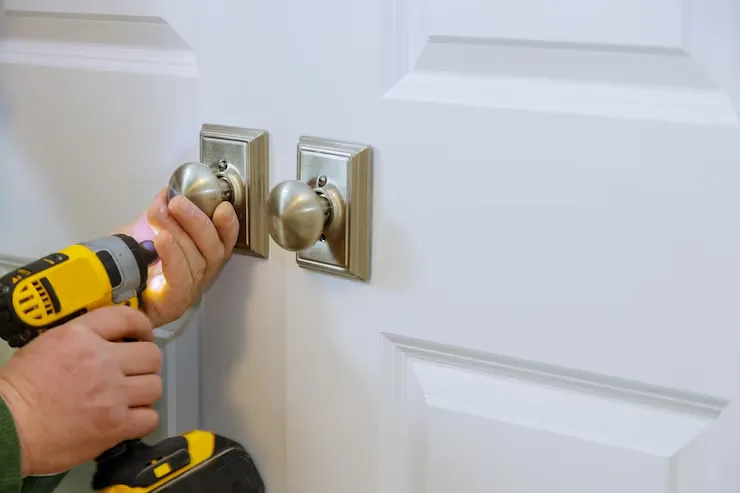
Huntington Beach runs on foot traffic. The restaurants along Pacific Coast Highway turn tables every night, the retail corridor on Beach Blvd pulls in weekend crowds, and the warehouses on the Gothard Street industrial corridor move people in and out on tight schedules. Every one of those buildings has exit doors, and a growing number of them are legally required to have panic hardware on those doors, not as a suggestion, but as a building code mandate enforced at inspection.
This guide breaks down what California’s building and fire codes actually require for panic bars and emergency exits, which Huntington Beach businesses the rule applies to, and what happens if your exit doors fall short. Golden Locks, Inc., a Huntington Beach locksmith and security contractor, installs and inspects this hardware across Orange County and sees the same gaps in commercial buildings again and again.
Are Panic Bars Required by Law in California?
Yes, but only for specific building types. California adopts the International Building Code with state amendments as the California Building Code (CBC), found in Title 24, Part 2 of the California Code of Regulations. The current edition is the 2025 CBC, based on the 2024 IBC, which took effect statewide on January 1, 2026. The California Fire Code (CFC), Title 24 Part 9, repeats the same egress hardware language in its own Chapter 10.
Section 1010.2.8 of the 2025 CBC is the operative rule. It states that swinging doors serving a Group A (assembly) or Group E (educational) occupancy with a calculated occupant load of 50 or more people cannot have any latch or lock other than panic hardware or fire exit hardware. Doors serving a Group H (high-hazard) occupancy require panic hardware regardless of how many people use the space. A related provision, Section 1010.2.8.2, extends the requirement to certain electrical equipment rooms, including transformer vaults, battery and energy storage rooms, and modular data centers.
That occupant load number is the key variable, and it is calculated, not estimated. Under CBC Table 1004.5, a restaurant dining area with standard tables and chairs is figured at 15 net square feet per person. A 750-square-foot dining room hits 50 occupants on paper, which means a mid-sized restaurant on Main Street or Pacific City can cross the panic hardware threshold without anyone realizing it during a remodel or a furniture rearrangement.
What Does Fire Code Say About Emergency Exits?
Beyond the panic hardware trigger itself, both the CBC and CFC set baseline rules for every required exit door in a commercial building, regardless of occupancy type or occupant load. An exit door cannot require special knowledge, a key, a code, or a tool to open from the inside. The City of Huntington Beach’s own fire code language is explicit on this point, stating plainly that egress doors shall not require special knowledge to open.
Doors serving rooms with an occupant load of 50 or more must swing in the direction of egress travel, not against it, so a crowd moving toward the exit pushes the door open rather than into it. Exit doors must also be tight-fitting and self-closing where required, and any door equipped with panic hardware must release with a single motion. No twisting a knob, then pushing, then pulling.
A fire exit hardware label means something specific here. Fire exit hardware is panic hardware that has additionally been tested and listed for use on a rated fire door assembly, and it cannot include a mechanical dogging feature that holds the latch retracted, because a fire door has to latch automatically every time it closes. Standard panic hardware on a non-fire-rated door is permitted to have dogging for daytime push-pull convenience.
The Hardware Standards Behind a Compliant Panic Bar
Code compliance is not just about whether a bar is present on the door. The device itself has to be listed by a nationally recognized testing laboratory to two separate standards. UL 305 is the Standard for Panic Hardware, and it governs the mechanical safety and latching performance of the device. ANSI/BHMA A156.3 covers exit devices more broadly and assigns a grade from 1 to 3, with Grade 1 representing the highest cycle and durability rating and the standard most commercial fire marshals expect on high-traffic doors.
A handful of physical specifications come straight out of the code and get checked at inspection. The actuating bar or touchpad must be mounted between 34 and 48 inches above the finished floor. It must extend across at least half the width of the door leaf. And it must release the latch with no more than 15 pounds of applied force, in a single pushing motion, without requiring tight grasping or pinching.
A push bar bought off a hardware store shelf can look identical to a code-compliant exit device and still fail every one of these requirements. If it lacks the UL 305 listing label, it is not legally panic hardware regardless of how it functions, and a fire inspector will cite it the same as a missing one.
Which Huntington Beach Businesses Actually Need Panic Bars
The 50-occupant rule only applies to Group A and Group E occupancies, so the answer depends on how your space is classified, not just how many people are inside.
– Restaurants, bars, and any venue with public dining or seating are Group A-2 occupancies, and they hit the 50-occupant threshold faster than owners expect because of how compact California’s occupant load factors are for assembly seating.
– Banquet halls, gyms with group class areas, theaters, and churches fall under Group A and follow the same rule once occupant load crosses 50.
– Daycares, schools, and tutoring centers are Group E and are held to the same standard, often at a lower occupant load given how those spaces are configured.
– Standard retail stores are Group M (mercantile) and offices are Group B. Neither triggers the blanket 50-occupant panic hardware rule on its own, though a large assembly area inside a Group M or B building, like an event space inside a retail center, can still trigger it for that specific room.
– Warehouses and light industrial buildings in the Gothard Street corridor are typically Group F or S, but any high-hazard storage area inside one of them is Group H and requires panic hardware no matter how few people work there.
This distinction matters because plenty of property managers assume their Group B office building is exempt across the board, when the real answer depends on whether a conference room, training room, or shared lobby crosses the assembly occupancy line.
Electrified Exit Devices, Access Control, and Free Egress
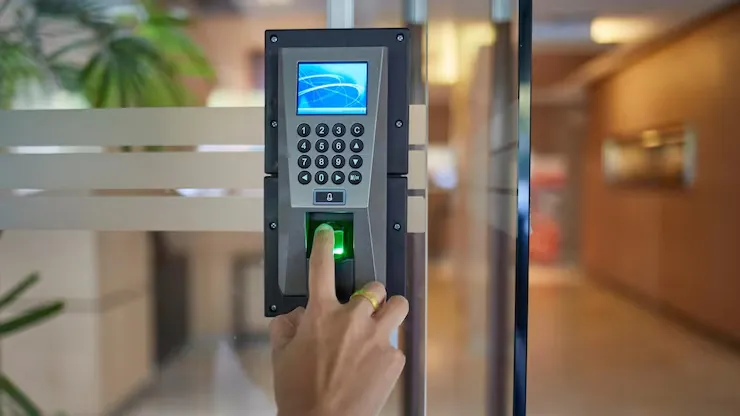
Many Huntington Beach businesses want keycard or biometric access control on the same doors that require panic hardware, and code allows it, with one non-negotiable condition. The exit side of the door must always allow immediate, hand-operated egress without a key, code, or delay, even when the entry side is electronically locked.
An electrified exit device handles this by combining the mechanical panic function with an electronic signal for access control integration, while including a mechanical override that keeps the door operable for egress during a power failure. wires and programs these systems so the access control side stays secure without ever compromising the exit side.
A separate exception exists for delayed and controlled egress hardware, which can hold a door closed for a short interval and trigger a local alarm before release. This option is restricted to specific occupancy types under the CFC and is not a general workaround for businesses that simply want fewer people using a particular exit.
Who Enforces This in Huntington Beach, and What Happens If You’re Not Compliant
The Huntington Beach Fire Department, not the Orange County Fire Authority, handles fire code enforcement and commercial inspections within the city. HBFD’s Community Risk Reduction division operates out of 2000 Main Street and conducts the routine commercial inspections that check exit hardware, fire alarm systems, and means of egress as part of standard fire safety compliance.
A failed inspection over non-compliant or missing panic hardware typically results in a correction notice with a deadline to fix the issue before re-inspection. Repeat or unresolved violations can escalate to occupancy or business license complications, and in the event of an actual fire or stampede incident, non-compliant exit hardware becomes a serious liability exposure for the property owner regardless of whether anyone was hurt by the hardware itself.
Keeping Panic Hardware Compliant Over Time
Hardware that passed inspection when it was installed does not stay compliant forever. A few practical habits keep a Huntington Beach commercial property ahead of its next HBFD visit:
1. Have exit devices inspected at least once a year, and twice a year for properties within a mile of the coast, where salt air accelerates corrosion in latch mechanisms and rod connectors.
2. Never let staff prop, tape, or wedge a sticking panic bar instead of having it repaired. A door held shut or held open against its design is itself a code violation.
3. Confirm the UL 305 and, where applicable, UL 10C labels are still legible on the device before assuming it is compliant.
4. Document every installation, repair, and replacement with brand, model, and listing information for your records and for the inspector.
5. Have a licensed contractor evaluate any door where the building’s occupancy use has changed, since a room reclassified for assembly use may now fall under the 50-occupant rule.
Installation and repair of this hardware in California requires a CA Locksmith License and, for most commercial door and low-voltage work, a CA Contractor License. [Golden Locks, Inc.](https://www.goldenlocks.net/commercial-locksmith/) holds both, and handles everything from a single corroded rim device to a full [commercial door repair](https://www.goldenlocks.net/services/commercial-door-repair/) where a misaligned frame is the real reason the hardware keeps failing.
Frequently Asked Questions
Do all commercial buildings in California need panic bars?
No. The panic hardware mandate under CBC and CFC Section 1010.2.8 applies to Group A (assembly) and Group E (educational) occupancies with an occupant load of 50 or more, and to Group H (high-hazard) occupancies at any occupant load. A typical Huntington Beach office or retail store does not trigger the rule unless it contains a qualifying assembly space.
How much occupant load triggers the panic hardware requirement?
Fifty people, calculated using the occupant load factors in CBC Table 1004.5, not a head count on a busy night. A restaurant dining area is figured at 15 net square feet per person, so a 750-square-foot dining room reaches 50 occupants on paper even if it never feels crowded.
Is a regular push bar the same as code-required panic hardware?
Not unless it carries a UL 305 listing label. Plenty of hardware-store crash bars look like panic hardware but were never tested to that standard, and a Huntington Beach fire inspector will treat an unlisted device the same as having no panic hardware at all on a door that requires it.
Can a business be cited for missing or non-compliant panic hardware?
Yes. Huntington Beach Fire Department inspectors check exit hardware during routine commercial inspections, and a violation typically results in a correction notice with a deadline to fix it before re-inspection. Unresolved violations can affect occupancy status and create significant liability exposure if an incident occurs.
Who inspects panic bars in Huntington Beach?
The Huntington Beach Fire Department, based at 2000 Main Street, handles commercial fire inspections within city limits rather than Orange County Fire Authority. Business owners with questions about a specific exit door can reach HBFD’s fire prevention staff directly at (714) 536-5411.
How often should panic hardware be inspected or replaced?
At minimum once a year, and twice a year for Huntington Beach properties within a mile of the coast, since salt air corrodes latch mechanisms and rod connectors faster than inland locations. Golden Locks, Inc. recommends scheduling inspections ahead of, not during, your HBFD fire inspection cycle.
A Compliance Check Costs Less Than a Failed Inspection
Most Huntington Beach business owners do not find out their exit hardware is non-compliant until a fire inspector flags it, and by then, the fix is happening on the city’s timeline instead of theirs. Golden Locks, Inc. holds CA Locksmith License #LCO4446 and CA Contractor License #988707, and evaluates occupant load, hardware listings, and door condition before recommending any repair or replacement. A walkthrough of your exit doors takes less time than a single re-inspection cycle. Call (714) 841-0141 or visit the panic bar installation page to schedule a compliance assessment for your Huntington Beach property.